
Measurement with the Light Microscope
Your microscope may be equipped with a scale (called a reticule) that is built into one eyepiece. The reticule can be used to measure any planar dimension in a microscope field since the ocular can be turned in any direction and the object of interest can be repositioned with the stage manipulators. To measure the length of an object note the number of ocular divisions spanned by the object. Then multiply by the conversion factor for the magnification used. The conversion factor is different at each magnification. Therefore, when using a reticule for the first time, it is necessary to calibrate the scale by focusing on a second micrometer scale (a stage micrometer) placed directly on the stage.
Identify the ocular micrometer. A typical scale consists of 50 - 100 divisions. You may have to adjust the focus of your eyepiece in order to make the scale as sharp as possible. If you do that, also adjust the other eyepiece to match the focus. Any ocular scale must be calibrated, using a device called a stage micrometer. A stage micrometer is simply a microscope slide with a scale etched on the surface. A typical micrometer scale is 2 mm long and at least part of it should be etched with divisions of 0.01 mm (10 祄).
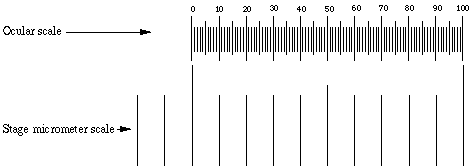
Suppose that a stage micrometer scale has divisions that are equal to 0.1 mm, which is 100 micrometers (祄). Suppose that the scale is lined up with the ocular scale, and at 100x it is observed that each micrometer division covers the same distance as 10 ocular divisions. Then one ocular division (smallest increment on the scale) = 10 祄 at 100 power. The conversion to other magnifications is accomplished by factoring in the difference in magnification. In the example, the calibration would be 25 μm at 40x, 2.5 μm at 400x, and 1 μm at 1000x.
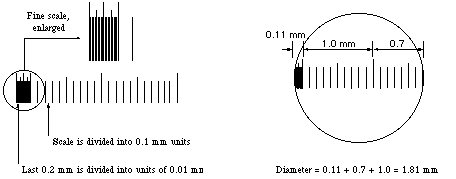
Some stage micrometers are finely divided only at one end. These are particularly useful for determining the diameter of a microscope field. One of the larger divisions is positioned at one edge of the field of view, so that the fine part of the scale ovelaps the opposite side. The field diameter can then be determined to the maximum available precision.
Be aware that even under the best of circumstances the limit of resolution of your microscope is 1 or 2 祄 (or worse) at any dry magnification, and 0.5 祄 or so using oil immersion. No directly measured linear dimension or value that is calculated from a linear dimension should be reported with implied accuracy that is better than that. That includes means, surface areas, volumes, and any other derived values. For example, suppose you measure the length of a flagellum on a Chlamydomonas cell at 400x, and determine that it covered 3 1/2 ocular divisions. The length is directly calculated as 3.5 divisions times 2.5 祄 per division, which comes out to 8.75 祄. You know, however, that at 400x the absolute best you can do is to estimate to the nearest 祄, so before reporting this measurement round it to 9 micrometers (not 9.0, which would imply an accuracy to the nearest 0.1 祄). For more information on reporting uncertain quantities see
The calculation of a volume is subject to error propagation, namely the magnification of an error when deriving a figure from one or more measured variables. For example, suppose you measure the length and diameter of an object to be 65 and 30 micrometers, respectively, assuming a cylindrical shape. The volume is given by the formula v = 紃2l, where r = radius and l = length. The formula gives a volume of 45, 946 祄3. The volume isn't accurate to the nearest cubic micrometer, however.
Let's make the very optimistic assumption that the measurement of 65 micrometers is indeed accurate to the nearest 1 祄. Then the number 65 means "greater than 64.5 and less than 65.5." The number 30 really means "greater than or equal to 29.5 and less than or equal to 30.5." The smaller set of measurements yields a volume of 44,085 祄3, while the larger yields a volume of 47,855 祄3. False precision would be implied even if one reported a volume of 46,000 祄3, obtained by rounding the middle measurement. It would probably be better to report a range in this case, of 44,000 to 48,000 祄3. By the way, 46,000祄3 is 0.046 mm3, which probably represents a better choice of units in this case.
In many areas of experimental science, including biosciences, the ability to estimate and make reasonable assumptions is a valuable skill. In order to make some quantitative estimates, particularly of volumes, you will have to make assumptions regarding the shape of some organisms. For example, if a specimen appears round, you would likely make your volume calculation based on the assumption that the specimen is a perfect sphere. For something like a Paramecium you might assume a cylindrical shape in order to simplify your estimate, while remaining aware that you could be way off the mark.
A specimen such as Chaos represents a real challenge. Ameoboid organisms are irregularly shaped most of the time. Is it flat on the slide, or does it extend up toward the coverslip? Perhaps it is attached to both. What model do you use as a basis for volume estimation? Is it best to assume a particular shape and take measurements at different times? Is it best to estimate a maximum and minimum for each possible dimension and obtain a range of possible volumes? Remember, you are only asked to estimate. Sometimes the best estimates have a potential error of more than an order of magnitude.
日前,國產期刊TheInnovation獲得首個影響因子(IF=32.1),成為科睿唯安JCR綜合性期刊分類下排名僅次于《自然》(IF=64.8)和《科學》(IF=56.9)的期刊,并且這本期刊在目前......
現在,美國的消費者可以預訂一種持續發光的基因工程植物了。美國48個州的居民只需花29美元就可以得到一株能持續發出淡淡綠色光芒的矮牽牛。美國生物技術公司LightBio將于4月份開始運送一批5萬株“螢火......
近日,服務科學領域的全球領導者賽默飛世爾科技(以下簡稱賽默飛)宣布,在達成收購意向兩個月之后,賽默飛以28億美元、折合人民幣約190億元的價格,完成了對TheBindingSiteGroup的全現金收......
11月15日,施普林格·自然和TheLens平臺宣布結成重要的合作伙伴關系,以更深入地揭示學術研究和數據如何能通過經濟和社會成效,加速推動創新的問題解決方式。通過將科學、投資和企業領域的開放數據更好地......
6月10日,QS教育集團正式發布了2021年世界大學排名,中國共有83所高校上榜,包括內地高校51所,港澳臺地區高校32所。中國大學的總體排名情況已經連續數年呈上升趨勢,今年再度刷新了榜單。大學排名,......
作為一種重要的植物激素,茉莉酸不僅調控植物對于機械損傷、昆蟲取食和腐生型病原菌侵害的防御反應,還參與調控諸多生長發育過程。basicHelix-Loop-Helix(bHLH)類型轉錄因子MYC2是茉......
ThePlantCell是植物領域的著名學術期刊,對植物學的發展起到了重要的引領作用。為慶祝創刊30周年,ThePlantCell雜志社邀請部分編委會成員及其他科學家對發表在該雜志的重要研究工作進行評......
8.476,這是長春光機所主辦的英文期刊Light獲得的第一個影響因子。從創刊至今,Light只有“兩歲半”,盡管年幼卻后勁十足——目前,它已發表來自19個國家/地區的97篇學術文章。知名學者評價:現......